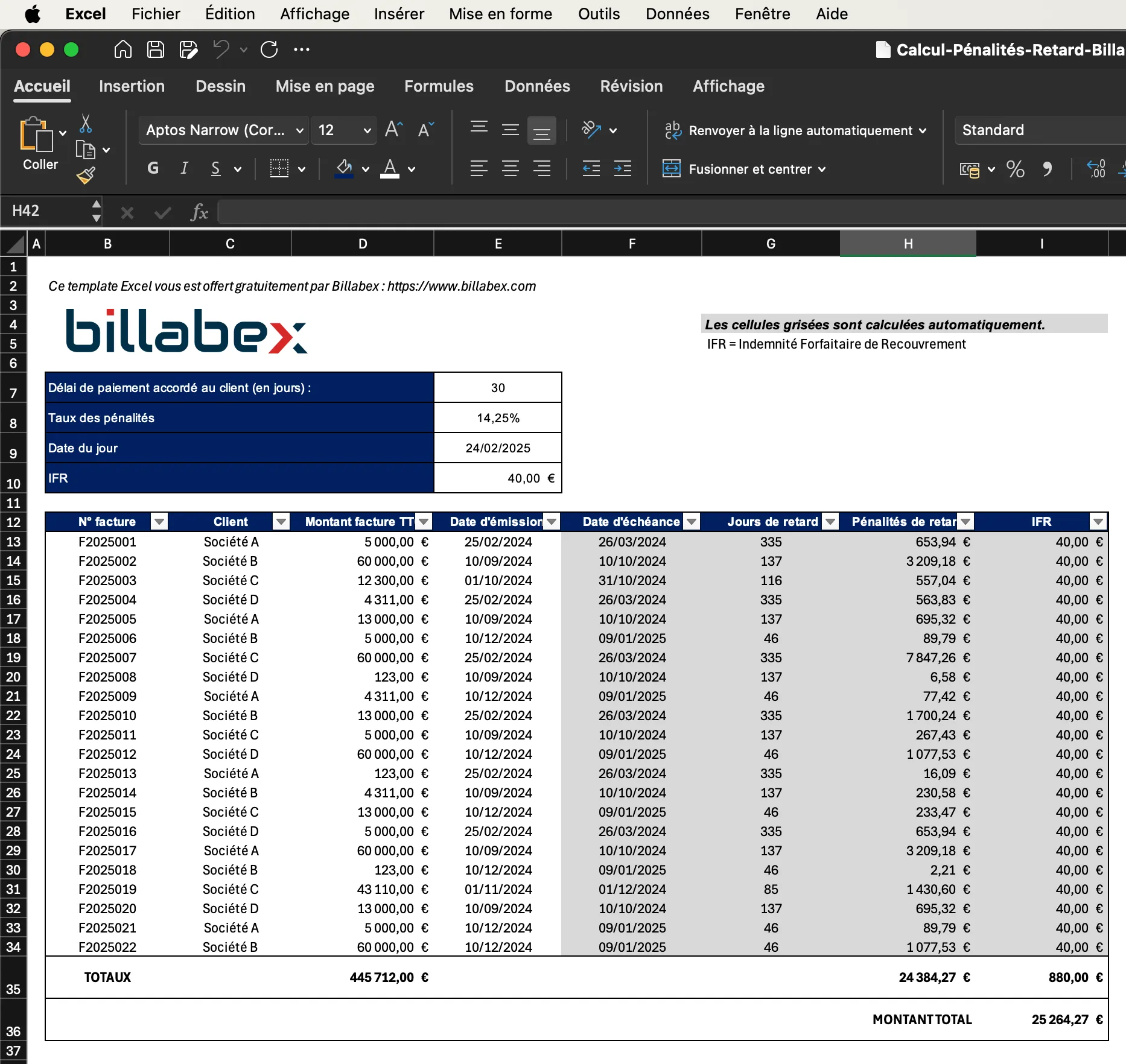
Late payment penalties are one of the most underused tools in the French SME’s financial arsenal. Many business owners know these penalties exist in theory but hesitate to apply them in practice — either because they do not know how to calculate them, or because they fear damaging the client relationship. Yet the law is clear: these penalties are owed automatically, without any prior formal demand, as soon as a payment deadline passes. Knowing how to calculate, document, and claim them is part of sound accounts receivable management. This guide walks you through everything: the legal basis, the calculation formula, worked examples, and the practical steps to issue a penalty invoice.
What Are Late Payment Penalties?
Legal definition
Late payment penalties (pénalités de retard) are a form of statutory compensation owed by a debtor who fails to pay a commercial invoice on time. They are governed by Article L441-10 of the French Commercial Code (formerly Article L441-6), which derives from the LME law of 2008 and the transposition of the European Late Payment Directive.
The underlying logic is simple: when a buyer delays payment, they are essentially obtaining an interest-free loan from their supplier. Late payment penalties correct this imbalance by making the delay financially costly for the debtor.
Key features of the French regime:
- Automatic — no court order or prior demand required
- Due from the first day of delay — the day after the contractual or statutory deadline
- Applicable to all B2B transactions — regardless of sector or company size
- Cannot be waived in advance — any contractual clause attempting to exclude them is void
When do they apply automatically?
Late payment penalties begin accruing on the calendar day immediately following the payment due date. If the invoice specifies a deadline of 31 March and the client has not paid by that date, penalties start on 1 April.
There is no grace period and no requirement to send a formal demand letter (mise en demeure) before penalties are triggered — unlike some other legal remedies. This makes them both powerful and simple to apply. That said, you do need to actually claim them: penalties are owed automatically in law, but you still need to issue a credit note or separate invoice to collect them.
How to Calculate Late Payment Penalties
The calculation formula
The formula for late payment penalties is straightforward:
Penalties = Outstanding amount × (Annual rate / 365) × Number of days late
Where:
- Outstanding amount = the gross invoice amount including VAT (TTC)
- Annual rate = ECB main refinancing rate + 10 percentage points
- Number of days late = calendar days from the day after the due date to the date of actual payment
The ECB rate is updated twice a year (1 January and 1 July). Always use the rate in force on the due date of the invoice, not the rate on the day you issue the penalty invoice.
Worked example
Let’s take a concrete scenario:
- Invoice amount: €5,000 including VAT
- Payment due date: 31 January 2026
- Actual payment date: 2 March 2026 (30 days late)
- ECB rate (1 January 2026): 3.65%
- Penalty rate: 3.65% + 10% = 13.65% per annum
Calculation:
Penalties = €5,000 × (13.65% / 365) × 30
Penalties = €5,000 × 0.000374 × 30
Penalties = €5,000 × 0.01120
Penalties = €56.06
In addition to the €56.06 in interest, a €40 flat-rate compensation is also due (see below), bringing the total claim to €96.06.
This is a modest amount for a single invoice — but consider a business with 200 invoices per year, 20% of which are paid 30+ days late: the unclaimed penalties can represent several thousand euros annually.
The €40 flat-rate compensation
Alongside interest penalties, every late payment automatically triggers a €40 fixed compensation (indemnité forfaitaire de recouvrement) for collection costs. This amount is set by decree and applies per invoice, per client.
Key rules:
- It is owed from day one of delay, without any formal request
- It cannot be waived contractually
- It is cumulative with interest penalties, not an alternative to them
- If actual recovery costs exceed €40 (e.g., you hired a collection agency), you may claim the additional amount with proof of expenditure
For example, if a client is late on 3 invoices simultaneously, you are entitled to 3 × €40 = €120 in flat-rate compensation, plus interest on each invoice.
Mandatory Mention in Terms & Conditions
What must the clause include?
French law requires sellers to include the following information in their general terms and conditions of sale (T&Cs):
- The applicable late payment penalty rate — the specific rate (e.g., “ECB main refinancing rate + 10 percentage points”) or the exact numerical rate
- The conditions and terms of application — i.e., that penalties are due automatically from the day after the payment deadline
- The €40 flat-rate compensation — explicitly mentioning the fixed indemnity
A typical clause reads: “In the event of late payment, penalties calculated at the ECB main refinancing rate plus 10 percentage points will be automatically applied from the day following the payment due date. A flat-rate compensation of €40 for collection costs will also be due.”
This clause must appear in your T&Cs and should ideally be referenced (or reproduced) on the invoice itself.
Common mistakes
Several errors are frequently made by businesses when it comes to late payment penalties:
- Stating a rate lower than the statutory minimum: Any rate below ECB + 10 points is void, and the statutory rate applies instead.
- Setting a penalty-free grace period: A clause granting a grace period after the due date before penalties apply is unenforceable under French law.
- Forgetting to update the rate: The ECB rate changes — make sure your T&Cs and invoices reference the “current ECB rate” dynamically rather than a fixed number.
- Treating penalties as optional: Some businesses never claim penalties, either by choice or oversight. This is not recommended for habitual late payers.
How to Claim Late Payment Penalties
How to invoice them?
To claim late payment penalties, you issue a separate credit note or penalty invoice addressed to the late-paying client. This document should include:
- Reference to the original invoice(s) concerned
- The number of days of delay
- The penalty rate applied and the calculation breakdown
- The penalty amount
- The €40 flat-rate compensation (listed separately)
- A new payment deadline for the penalty invoice
There is no legal obligation to send a formal demand letter before issuing a penalty invoice — but in practice, a prior reminder email or letter improves collection rates and preserves the commercial relationship.
What if the client disputes?
Clients sometimes push back on penalty invoices, arguing that the delay was caused by a dispute over the original invoice or an internal processing error. Here is how to handle this:
- Disputed invoices: If the client raised a genuine dispute before the due date, penalties may not be enforceable for the disputed portion — but this must be documented. If no dispute was raised before the due date, penalties are owed in full.
- Internal processing errors: These do not excuse late payment under French law. The legal obligation is on the buyer to pay on time.
- Partial payment: Penalties accrue on the outstanding balance, not the full invoice amount, once a partial payment has been received.
If a client refuses to pay after receiving a penalty invoice, you may escalate through standard debt collection channels — a formal demand letter, mediation, or legal action.
Automate with Billabex
Tracking overdue invoices, calculating the correct penalty amount for each, and issuing penalty invoices manually is time-consuming and error-prone — especially once your client base grows. Billabex automates the entire process: it monitors every invoice’s due date, calculates penalties automatically using the current ECB rate, and generates the relevant penalty documentation. This means you never leave money on the table, and your accounts receivable management remains compliant with French law at all times.
Conclusion
Late payment penalties in France are straightforward to calculate and legally robust — but they only work if you actually apply them. Include the right clause in your T&Cs, track your payment deadlines rigorously, and do not hesitate to issue penalty invoices when clients breach their commitments. Combined with the €40 flat-rate compensation, these tools give French suppliers a meaningful financial lever to incentivise timely payment and recover costs when clients pay late.