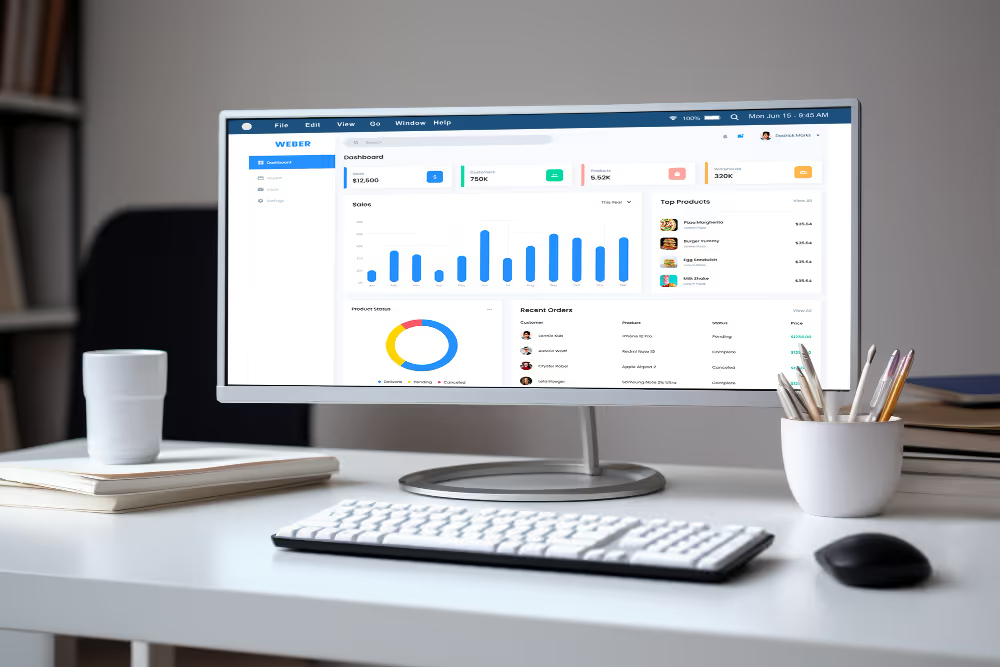
Debt collection is a critical concern for businesses, whether they are small or medium-sized enterprises (SMEs) or large corporations. Late payments from clients can lead to significant disruptions in cash flow, affecting the financial stability and growth of the company.
AI-powered Debt Collection Software is emerging as an innovative solution to enhance collection processes, reduce payment delays, and optimize accounts receivable management.
This article delves into what these software solutions are, how they work, and what they bring to the table compared to traditional methods. Additionally, don’t miss our comprehensive guide on following up on unpaid invoices.
What is AI-Powered Debt Collection Software?
AI-powered Debt Collection Software is a technological solution designed to automate and optimize the debt collection process. These tools leverage advanced machine learning algorithms and artificial intelligence to analyze data, predict customer payment behaviors, and determine the most effective collection strategies. Unlike traditional debt collection software, which relies primarily on fixed rules and manual actions, AI-driven systems continuously adapt to the behaviors and trends detected in both historical and real-time data.
Key AI Features in Debt Collection Software
Modern debt collection software can include a variety of AI-driven features, such as:
-
Predictive Analytics: AI can forecast the likelihood of an invoice being paid on time or late. It can also estimate the probable payment date, helping businesses better manage their cash flow.
-
Automated Reminders: AI personalizes follow-ups based on the client’s payment behavior. For instance, a customer who responds better to emails than phone calls will be automatically contacted through their preferred channel.
-
Optimization of Collection Strategies: AI learns from past interactions to identify which strategies are most effective, adjusting actions in real-time to maximize recovery chances.
-
Risk Management: AI helps identify high-risk clients who are likely to default and adjust credit terms or collection strategies accordingly.
AI-Powered Virtual Agents: The Example of Billabex
Some software solutions take it a step further by incorporating a full-fledged AI virtual agent capable of autonomously managing the entire debt collection process. Billabex is a notable example of such software. This AI agent performs follow-ups, negotiates payment plans with clients, and can even recommend legal actions in case of non-payment. It functions like a real debt collector but with enhanced efficiency and precision that AI provides.
How AI is Revolutionizing Debt Collection
A More Proactive and Personalized Approach
One of the key contributions of AI in debt collection is the ability to take a proactive rather than reactive approach. Traditional debt collection software is often limited by fixed rules and cannot adapt to the nuances of client behavior. AI, on the other hand, continuously analyzes data and adjusts collection strategies accordingly. This leads to a higher level of personalization in actions, which can significantly improve recovery rates.
Reducing Payment Delays
Through process automation and predictive analytics, AI-powered debt collection software can significantly reduce payment delays. By identifying at-risk invoices and automating follow-ups at the optimal times, AI helps businesses get paid faster.
Optimizing Human Resources
For companies, especially those dealing with a high volume of invoices, AI allows collection teams to focus on more complex or strategic cases where human intervention is essential. Rather than spending time on repetitive and time-consuming tasks, agents can concentrate on high-value activities.
Enhancing Client Relationships
Another revolution brought by AI is the improvement of client relationships in the context of debt collection. Automated and personalized reminders are less intrusive and better received by clients, allowing businesses to maintain good relationships while ensuring payments are collected. Furthermore, by adjusting approaches based on client preferences, companies can avoid disrupting valuable commercial relationships.
Benefits of AI-Powered Debt Collection Software for SMEs and Large Corporations
For SMEs
For small and medium-sized enterprises that issue a limited number of invoices, using AI-powered debt collection software offers several advantages:
-
Increased Efficiency: With limited resources, SMEs can automate collection tasks, allowing them to focus on their core business.
-
Access to Advanced Technologies: AI democratizes access to tools previously reserved for large companies, enabling SMEs to use sophisticated collection strategies at a lower cost.
-
Prevention of Payment Delays: SMEs, which are more vulnerable to payment delays, can better anticipate cash flow problems thanks to AI’s predictive analytics.
For Large Corporations
Companies that generate a high volume of invoices can also benefit greatly from these technologies:
-
Scalability: AI-powered software can handle a large number of invoices and follow-ups efficiently without requiring a proportional increase in human resources.
-
Advanced Data Analysis: AI allows for the analysis of massive amounts of data to identify trends and risks that would be difficult to detect manually.
-
Optimization of Cash Flow: By reducing payment delays and improving collection rates, AI helps stabilize cash flow, a key element for large corporations.
What’s the difference between Artificial Intelligence, Machine Learning, and Deep Learning?
Artificial Intelligence (AI), Machine Learning (ML), and Deep Learning (DL) are related but distinct concepts. Here’s a summary of their differences:
Artificial Intelligence (AI):
General definition: AI refers to the ability of a machine to mimic human intelligent behaviors like decision-making, problem-solving, and learning.Scope: AI encompasses a wide range of technologies, including basic algorithms (predefined rules) and more sophisticated systems capable of learning and adapting.Example: Virtual assistants, recommendation systems (like those from Netflix or Amazon).
Machine Learning (ML):
Subfield of AI: Machine Learning is a branch of AI that allows machines to learn from data without being explicitly programmed for each task.How it works: ML algorithms use data to create models that can make predictions or decisions.Example: Image recognition, predictive market trend analysis.
Deep Learning (DL):
Subfield of Machine Learning: Deep Learning is a subset of Machine Learning that relies on artificial neural networks, inspired by the human brain, to analyze complex data.Key feature: DL uses layers of artificial neurons to learn abstract representations of data. The more layers, the better the model can process complex information.Example: Voice recognition, autonomous vehicles, image and video processing.
In summary, AI is the overarching concept, Machine Learning is a subcategory that allows systems to improve using data, and Deep Learning is an advanced Machine Learning method using neural networks to process complex information.
The Best AI Debt Collection Software in 2026
The AI debt collection software market has evolved considerably over recent years. Here is an overview of the most advanced solutions available in 2026:
Billabex | The Autonomous AI Agent
Billabex represents the new generation of debt collection software: a fully autonomous AI agent that handles the entire follow-up process without human intervention. The AI analyzes each debtor’s profile, drafts personalized messages, and adapts its strategy based on responses received.
Key strengths:
- Completely autonomous AI agent, no human intervention required
- Advanced personalization of tone and content based on client profile
- Integrated multichannel (email, SMS, registered mail)
- Integration with major accounting software (Sage, Pennylane, QuickBooks)
- From €49/month
Clearnox | The Collaborative AI Platform
Clearnox integrates AI features into a collaborative platform. The AI assists credit teams but requires human validation for sensitive actions. Well-established in the French market, primarily targeting SMEs and mid-market.
Highradius | The Enterprise AI
Highradius is an American enterprise solution that has integrated AI into its Credit-to-Cash modules. Very powerful in predictive analytics, suited for large companies with dedicated teams and high invoice volumes.
Sidetrade | French Predictive AI
Sidetrade offers predictive AI that analyzes payment behaviors and anticipates default risks. A premium solution targeting French mid-market and large companies.
For a full comparison of debt collection software, see our dedicated guide.
ROI of AI Debt Collection Software
The investment in AI debt collection software pays off quickly. Here are figures observed among Billabex clients and industry studies:
Measurable Gains
| Metric | Without AI | With AI | Improvement |
|---|---|---|---|
| Average DSO | 52 days | 35–38 days | -30 to -45% |
| Amicable recovery rate | 60–70% | 85–95% | +25 points |
| Time spent on follow-ups | 8–12h/week | <1h/week | -90% |
| Cost per invoice processed | €15–25 | €2–5 | -80% |
ROI Calculation: Concrete Example
Consider an SME with 200 invoices/month, DSO of 52 days, and €2M annual revenue:
- Cost of trade credit (capital tied up): 52/365 × 2,000,000 × 3% (borrowing rate) = €8,548/year
- DSO reduction with AI: -17 days → saving of €2,803/year in financing costs
- Time freed up: 10h/week × 52 weeks × €35/h = €18,200/year
- Software cost (Billabex): on request, a fraction of the gains above
Estimated annual gains: over €21,000, for a software cost that represents only a small fraction of that return.
Conclusion
AI-powered Debt Collection Software represents a significant advancement for businesses looking to optimize their accounts receivable management. Whether for an SME or a large corporation, these tools offer solutions tailored to specific needs by automating processes, personalizing collection strategies, and improving payment rates while preserving client relationships. In a world where speed and efficiency are crucial, AI is becoming an indispensable ally in debt collection.